Floating on a continuum

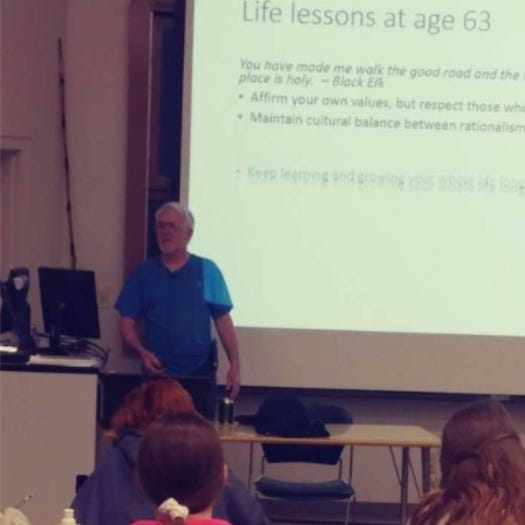
Back when I was still teaching, I used to begin a lecture on psycholinguistics by telling students, “Reality is continuous, but language is dichotomous.”
That’s not completely true, but I was teaching at the undergraduate level, where vague statements are permissible. In most instances, though with some significant exceptions, the statement is valid. For instance, we divide people linguistically into “tall” versus “short” people (many descriptors have antonyms), but there is no defined demarcation point that divides the tall from the short, nor the rich from the poor, the young from the old, and so forth. In using language (at least languages like English, which are prototypical in this regard), we speak as if all categories were pigeonholes, either all this or all that. We know better, of course, except when we don’t. But when we forget, bad things happen, like the events in Rwanda during 1994.
So with grief. We tend to think of ourselves (when we think about it at all) as either grieving or not grieving, but in reality, there is a continuum, with “utterly devastated” on one end. For a very long time after I was no longer entirely broken and crushed, I was sad, and it was a slow process to “integrate my grief” (as the counseling profession puts it). I have substantially, but of course not completely, done that.
For instance, today I loaded up two large boxes with items that remain in my old home in preparation for either tossing or donating most of them, and a few were still grief triggers. They brought only a momentary tang of sadness, but a fleeting emotion is an emotion still. In the early days of grief, I desperately feared that I would somehow forget Diane, which I now know to be impossible; we are all prone to flee to one side of a dichotomy for fear of falling headlong into the other, and have a hard time finding the place of balance in the middle, the via media.
When water turns to ice, because of how the process works, there are always fractal boundaries on the surface of the ice where the growing crystals don’t mesh or align. The mind is something like this as well. Neuropsychologists used to think that the brain was “modular” (separate plug-and-play components that worked independently of others), and much ink was spilled over a debate about this; no one now believes this, but there was a grain of truth in the idea, as there is in most ideas. When we are recalling happy memories, the brain is primed to remember other happy memories, so we look back (often) at our past through a rosy glow of nostalgia that is selective, though not entirely inaccurate. But when a griever encounters a trigger, that primes the brain to remain difficult times from the past, so at first it is hard not to get stuck in a doom loop. Eventually, if we do our so-called “grief work” (it is work, literally, as it burns glucose), we can turn down the emotional volume on triggers so that they cause only a slight pang of sadness, not an explosion of misery. This works in part because the brain starts to cover over the worst memories with a soothing balm of repression, for which I am grateful.
So I’m grateful that my grief is now floating on a continuum, an ingredient now mixed thoroughly into the whole, which doesn’t dominate my life any more but which has shaped and changed me, mostly for the better but at a significant cost. I am happy and grateful every morning. I’m in love with Susan and enjoying our shared life. I have many smiles and few tears. But the grief still lives in the attic of my mind, where it resides with a box of old 8-track tapes, a few mood rings, and a “peace now” button from my hippie wannabee days. And it’s welcome there, because the past deserves a place of respect, though we should not live there, and now is the acceptable time.